The kitchen is the most time-consuming room in any deep clean — 1.5 to 2 hours for a standard 3-bedroom Wangaratta home. It is also the room where the difference between a regular wipe and a true deep clean is most visible. Here is the step-by-step breakdown of what we tackle, in what order, and why.
Why the kitchen takes so long
A regular weekly clean of a kitchen is mostly surfaces — wipe the benches, mop the floor, do the dishes. A deep clean is 7-8 zones of detail work that a regular pass never touches: the inside of the oven, the range hood filters, behind the appliances, the splashback grout, the cupboard interiors, the kickboard channel, the toe of the dishwasher cavity, and the back of the tap area. Each one takes 10-20 minutes when done properly.
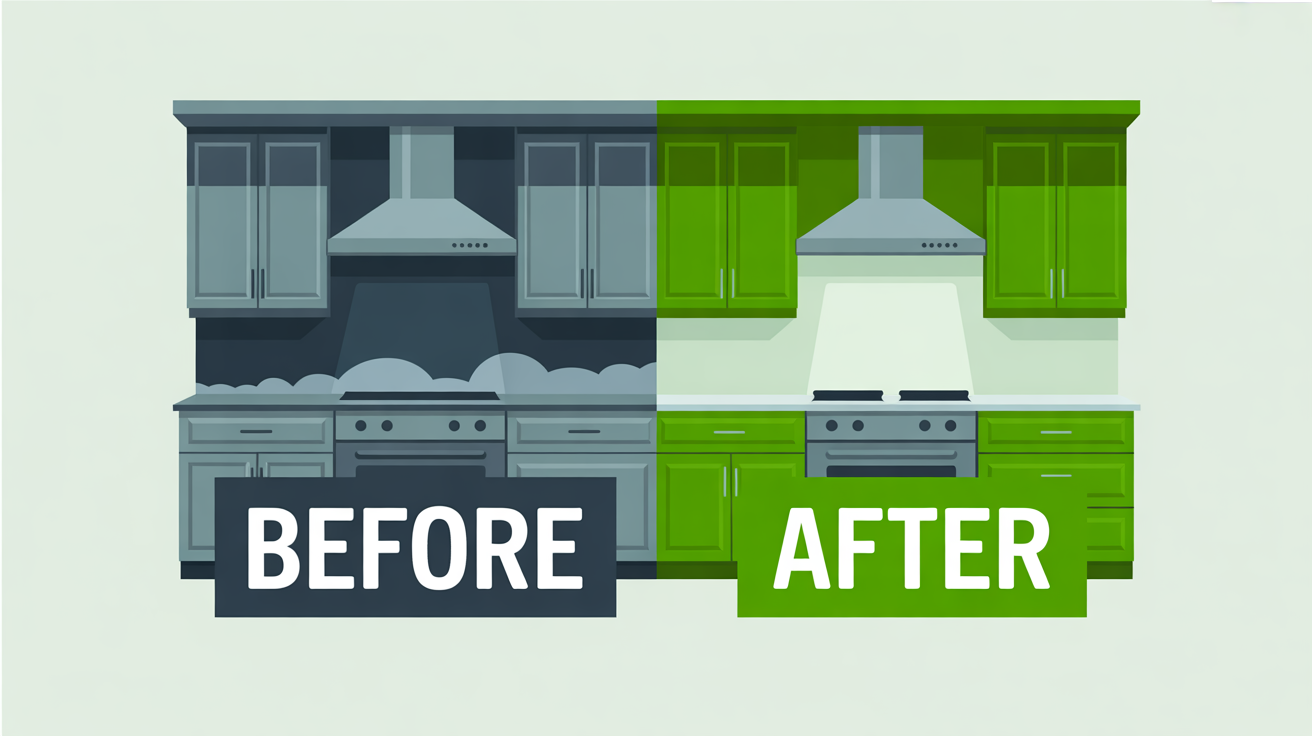
The result is a kitchen that does not just look clean — it smells different, feels different, and stays cleaner for longer because the grease and grime baseline has been reset.
The order — what to clean first and why
The order matters because grease falls and water spreads. Wrong order and you spend the day re-cleaning surfaces.
- 1. Range hood filters first. Pop the filters out, drop them in a sink of hot water with degreaser. They soak while you work on everything else.
- 2. Top of cupboards + top of fridge. Dust falls. Clean the highest surfaces before anything below.
- 3. Oven interior. Apply oven cleaner, leave it to dwell. Move on to other work while it activates.
- 4. Cupboard fronts and interiors. Wipe inside and out. Top hinges, handles, the back wall of the cupboard.
- 5. Benches and splash-back. Now the worst dust is gone, surfaces can be cleaned without immediate re-contamination.
- 6. Tapware + sink. Descale, polish.
- 7. Oven walls + door + racks. The dwell time is up. Scrub, wipe, rinse, dry.
- 8. Behind and under appliances. Pull out the fridge, dishwasher, oven (if possible). Vacuum the floor, wipe the wall behind, reset.
- 9. Floor + kickboards last. Vacuum and mop the floor as the final pass — everything dropped during cleaning is picked up.
Inside the oven — the hardest part
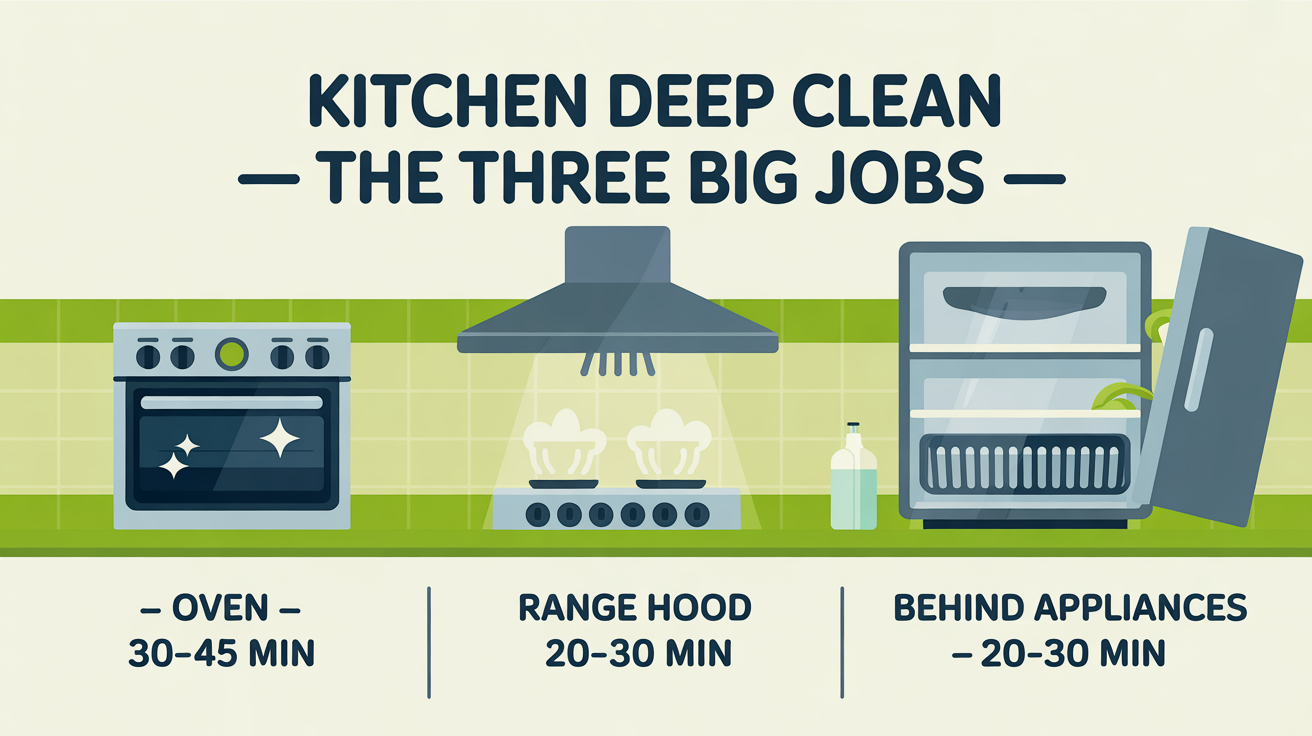
The oven is the single time-consuming item in any kitchen deep clean — 30-45 minutes if it has not been done in a year, 15-20 minutes if it gets a deep clean every 6 months.
- Remove racks, side runners, and pizza stones — soak in hot water + degreaser
- Apply oven cleaner to walls, floor, ceiling, and door glass — dwell 20+ minutes
- Scrub with non-abrasive pad — abrasive pads can scratch oven enamel
- Wipe down with damp microfibre — multiple passes to remove every trace of cleaner residue
- Dry thoroughly before reinstalling racks (wet racks slide back into a hot oven and burn)
- Check door seal — if cracked or warped, the oven loses heat and uses more power
Important note: NEVER use commercial oven cleaner on self-cleaning ovens (they have a special enamel coating that the harsh chemicals damage). Use bicarbonate-of-soda + water paste instead. Always check your oven manual first.
Behind and under appliances — the forgotten zone
This is the work that most “deep cleans” advertised online quietly skip. Pulling out the fridge, dishwasher, and oven adds 20-30 minutes but is the single change that makes a kitchen feel genuinely reset.
- Behind the fridge. Years of dust, fallen food, occasional pet hair. Vacuum thoroughly, wipe the wall. Check the condenser coils — clean coils run cooler and use less power.
- Under the dishwasher. Floor seal often retains water that smells stale. Vacuum, mop, dry.
- Behind the oven. Grease splatter accumulates on the wall behind. Wipe with degreaser, rinse with clean water.
- Toe-kick channel. The narrow gap under the bottom of cabinets. Vacuum with a crevice tool — collects amazing amounts of crumb and dust.
Ready for a kitchen that feels actually reset?
Free walkthrough. Fixed price. The full kitchen, top to bottom.
Range hood + filters — the grease problem
Range hood filters left for more than 6 months accumulate baked-on grease that mesh detergents cannot remove with a quick wipe. They need a hot soak in degreaser for 30+ minutes, scrubbed thoroughly, rinsed twice, dried, and reinstalled.
A clogged range hood works harder to pull air, uses more power, and pushes grease vapour back into the room instead of extracting it. Clean filters every quarter and the lifetime of the unit doubles.
If your filters look beige rather than silver, or if you cannot read the mesh pattern through the grease layer, you are due. We typically replace them on a deep clean if they cannot be saved — $80-$150 for a standard set.
Cupboard interiors and drawers
Open every cupboard and drawer. Look at the top inside surface — that is where dust falls and stays. Vacuum first (crumbs, dust). Then a damp microfibre with neutral cleaner.
- Empty out cupboards in sections, not all at once
- Wipe shelves, sides, back wall, and door interiors
- Wipe handle bases — the bit you do not see, that catches finger sweat
- Reorganise as you reload — chance to move things back where they should live
- Drawer slides: a drop of silicone lubricant if they squeak (NOT WD-40 — too volatile)
What you can do weekly to make the next deep clean shorter
The deep clean does the heavy lifting. These three weekly habits stop the heavy build-up between visits.
- Wipe the range hood once a week. 2 minutes with vinegar spray. Stops grease setting.
- Run the oven wipe cycle if your oven has one. 5 minutes. Reduces baked-on residue.
- Squeegee the splashback after cooking. Steam and grease leave a film that hardens. Wiping while still damp is 10× easier.
When to call us
Most homes need a kitchen deep clean every 4-6 months, and a full home deep clean (including the kitchen) every 6-12 months. If any of these apply, you are overdue:
- Range hood filters look beige or have a visible grease film
- Oven door glass has a brown film you cannot wipe off
- Top of fridge has a dust crust
- Cupboard handles feel slightly sticky
- Splashback grout has shifted from white to grey
Request a free quote or call 0493 295 032. We service Wangaratta, Beechworth, Benalla, Bright, Myrtleford, and 90+ towns across Northeast Victoria.
- ✓Range hood filters look beige or have a visible grease film
- ✓Oven door glass has a brown haze you cannot wipe off
- ✓Top of fridge has a visible dust crust
- ✓Cupboard handles feel sticky
- ✓Splashback grout has shifted from white to grey
- ✓There’s a faint stale-grease smell when you open the oven
- ✓Range hood is louder than it used to be
Frequently Asked Questions
How often should I deep clean my kitchen?+
Will you clean inside my self-cleaning oven?+
Do I need to empty my cupboards before you arrive?+
Can you pull out my fridge?+
Are oven cleaners safe around food?+
How long does a kitchen-only deep clean take?+
Do you bring your own oven cleaner and degreaser?+
Will the kitchen smell of chemicals when you leave?+
Sources & further reading
- Consumer guarantees on services Australian Competition and Consumer Commission
- Cleaning the home — Better Health Channel Victorian Department of Health
- Indoor air quality at home — guidance Australian Government Department of Health
- Reducing your home energy bills Australian Government — Department of Climate Change, Energy
- Construction dust — workplace guidance WorkSafe Victoria
Ready for a Real Kitchen Deep Clean?
Free quote. Fixed price. Wangaratta + 90 towns across Northeast Victoria.