A deep clean looks expensive when you book it. It looks cheap when you look at what it stops you spending — on weekly cleans, on replacing damaged tapware and grout, on power bills from clogged appliances. Here is the maths that explains why the most reliable deep-clean customers are the ones doing it on schedule.
The honest pricing — what a deep clean actually costs
For a 3-bedroom Wangaratta home, our deep cleans land between $480 and $680, depending on size, condition, and the depth of the brief. That is roughly the cost of 6-8 regular weekly cleans, or one good dinner out for four. The question is whether that visit, twice a year, saves you more than the $960-$1,360 it costs across 12 months. Usually, yes. Here is how.
Saving #1 — your weekly cleaner finishes faster
The single biggest hidden cost of skipping deep cleans is that your regular weekly clean takes longer over time. A weekly cleaner working on a home with a 12-month baseline of accumulated grime is fighting an uphill battle every visit. Wiping benches takes longer because the grease is thicker. Bathroom sessions stretch because the grout and tapware need more work each time.
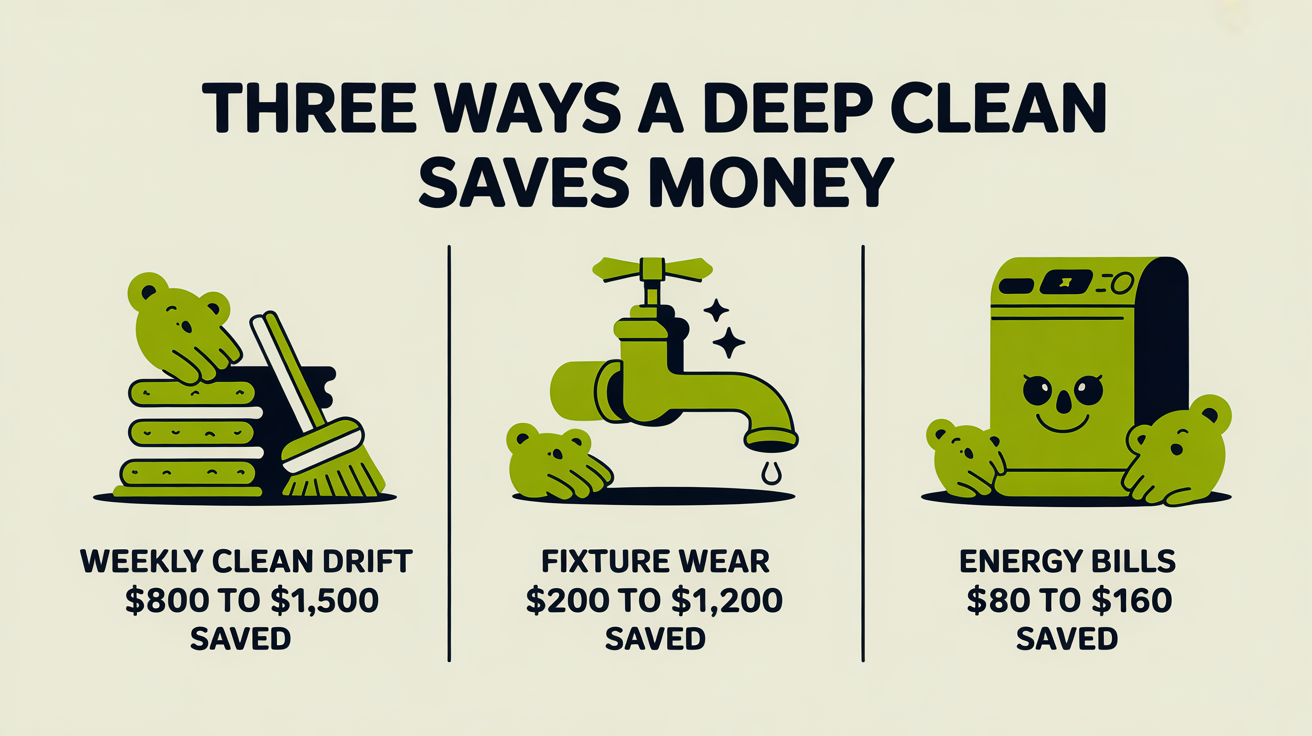
In real numbers: a weekly clean of a 3-bed home that takes 1.5 hours in month 1 will often take 2 hours by month 9. At standard hourly rates, that is an extra $20-30 per week — $1,000-$1,500 per year, just absorbed quietly. A twice-yearly deep clean resets the baseline. The weekly cleaner is back to 1.5 hours after each reset. The annual saving on regular cleans alone covers the deep cleans almost twice over.
Saving #2 — fixtures and finishes last longer
Soap scum on chrome tapware is not just visual — left for months, it etches the chrome plating. Mineral build-up on shower glass can permanently fog the surface. Discoloured grout that has been grey for two years is much harder to bring back to white than grout cleaned every six months. A complete bathroom regrout in Wangaratta is $400-$1,200; replacing pitted tapware in a single bathroom is $200-$500.
Range hood filters that have not been cleaned for a year often need replacing — $80-$150 a set. Carpets with embedded grime wear faster underfoot, lose loft, and need professional steam cleaning more often. The savings here are not on every household, every year — but every 3-5 years, most homes have one or two of these items hit. A regular deep clean keeps them out of replacement territory.
Saving #3 — appliances run more efficiently
A clogged range hood filter forces the fan to work harder. A dishwasher with months of grease build-up around the spray arms uses more hot water per cycle. A clothes dryer with a lint-clogged duct can use 20-30% more energy. Ovens with baked-on residue heat unevenly and overcompensate.
None of these are huge individually — but for an average household, they add up to roughly $80-$160 per year in extra power bills, all of which a proper deep clean addresses on the same day as the regular work. The Australian Government estimates that household appliance efficiency loss from neglect adds 5-8% to typical annual electricity bills.
Want the annual cleaning bill that actually saves money?
Free walkthrough. Fixed price. Same owner-operator every visit.
The annual maths — three scenarios for a 3-bed home
To make the trade-off concrete, here are three real scenarios for an average 3-bedroom Wangaratta family home. Numbers are indicative — actual quotes vary by home size and condition.
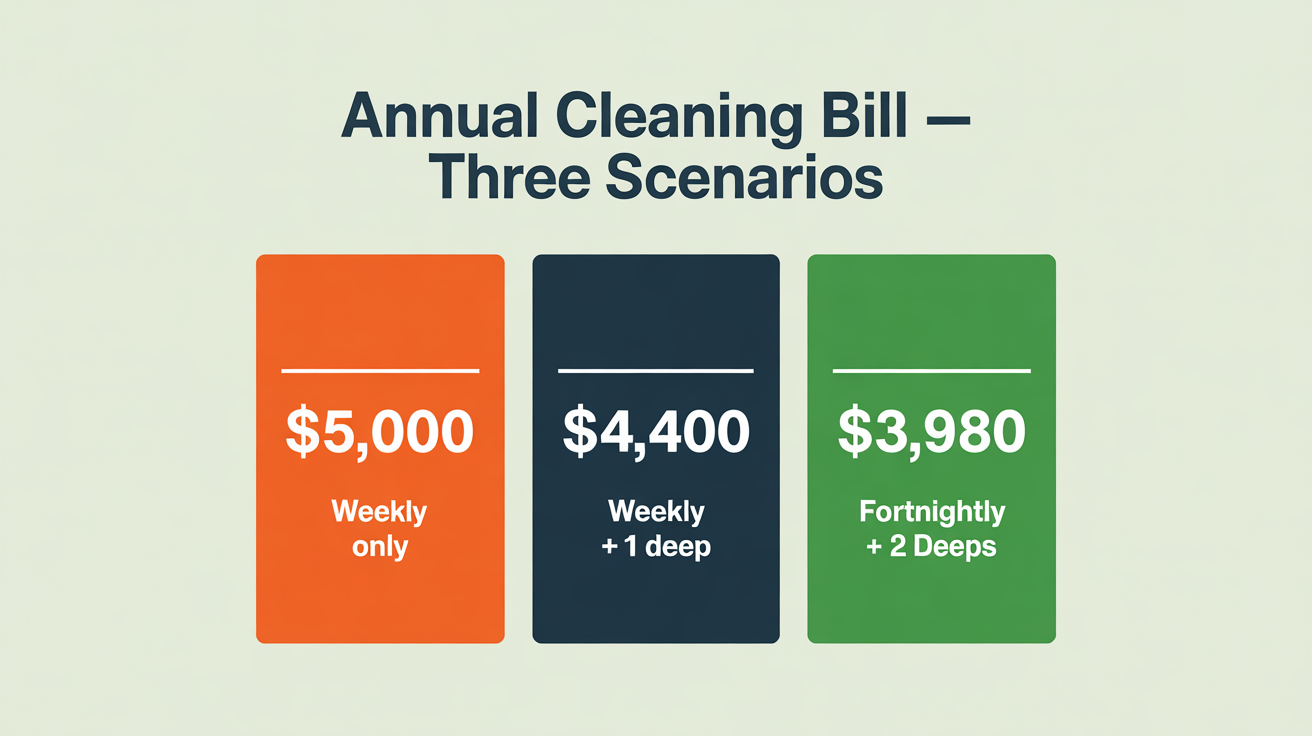
- Weekly clean only, no deep cleans. Weekly: $80 × 50 weeks = $4,000. Add ~20% drift over the year as the regular gets longer = ~$800 extra. Add ~$200 in compounding fixture damage. Year total: ~$5,000.
- Weekly clean + 1 deep clean. Weekly: $80 × 48 weeks = $3,840. One deep clean: $560. Regular reset stops the drift cost. Minor fixture compounding. Year total: ~$4,400.
- Fortnightly clean + 2 deep cleans. Fortnightly: $110 × 26 = $2,860. Two deep cleans: $560 × 2 = $1,120. No drift cost. No fixture compounding. Home looks consistently better. Year total: ~$3,980.
The fortnightly-plus-two-deeps option saves about $1,000 per year compared to weekly-only — and produces a noticeably better-looking home. Most households we move onto this schedule stay there.
Indicative annual totals for a 3-bedroom Wangaratta home. Actual numbers vary — we provide a fixed quote after a free walkthrough.
When DIY beats hiring — and when it really doesn’t
If you have a free weekend and you genuinely enjoy cleaning, doing your own deep clean is a real option. For a 3-bedroom home, plan 12-16 hours of work — about a full Saturday and most of Sunday — and budget $80-$120 in supplies if you do not already have a good vacuum, a steamer, a grout brush, a citrus dissolver, and microfibre cloths.
Where DIY loses the maths: when your time is worth more than $25-$30 per hour, when you do not own the right tools and would need to buy them once, or when your existing back, knees, or shoulders make 12 hours of physical work unappealing. For most working adults in Wangaratta, the maths favours hiring. For retirees on a tight budget who enjoy the satisfaction, DIY makes more sense.
The hidden value — the things that don’t show up on a bill
The cost savings are easy to measure. The harder-to-measure benefits matter more for many households:
- You stop noticing the home. A clean home recedes from your mental load. Cluttered or grimy homes generate a low-level background stress that compounds over months.
- Guests are easier. You can have anyone over, any time, without a panic clean first.
- Allergies and asthma ease. For households with anyone sensitive, this often outweighs the financial saving.
- Resale value holds. Homes that have been deep-cleaned on schedule sell faster and present better when photographed.
Why our prices stay flat — fixed quotes, no surprises
We quote a fixed price for every deep clean after a free walkthrough. If we find more than expected, that is our problem, not yours — we will still finish the brief at the quoted price. If we finish faster than expected, we either use the time on bonus items you flag or finish early. No hourly surprises, no upsells on the day.
The maths in this article assumes our standard pricing. To find out where your home actually lands, request a free quote or call 0493 295 032. We service Wangaratta, Beechworth, Benalla, Bright, Myrtleford, and 90+ towns across Northeast Victoria.
- ✓Your weekly clean is taking longer this month than 6 months ago
- ✓Bathroom tapware is starting to show pitting or fogging
- ✓Range hood is louder than it used to be
- ✓Dishwasher needs two cycles for one dirty load
- ✓Power bill has crept up despite no usage change
- ✓Last deep clean was more than 9 months ago
- ✓You feel slightly stressed about the state of the home most weeks
Frequently Asked Questions
Will the regular clean really get shorter after a deep clean?+
How quickly does the saving show up?+
Is the saving the same for renters?+
Do I need to commit to a schedule?+
Can you bundle the deep clean with the regular clean to save money?+
What’s the cheapest combination for a 3-bedroom home?+
Will I notice the difference on my power bill?+
What if I just want to skip the deep cleans this year?+
Sources & further reading
- Consumer guarantees on services Australian Competition and Consumer Commission
- Indoor air quality at home — guidance Australian Government Department of Health
- Cleaning the home — Better Health Channel Victorian Department of Health
- Reducing your home energy bills Australian Government — Department of Climate Change, Energy
- Indoor allergens and asthma triggers Asthma Australia
Ready to Save Across the Year?
Free quote. Fixed price. The schedule that actually drops your annual cleaning bill. Wangaratta + 90 towns across Northeast Victoria.