Most cleaners will tell you twice a year. Some will say four times. The honest answer depends on how many feet, paws, and tiny hands move through your home each week. Here is how to choose the frequency that actually fits.
The 6–12 month rule — and where it breaks
Walk into any cleaning blog and the answer is the same: deep clean your home every six to twelve months. That advice is fine for a two-person household with no pets, no kids, no allergies, and no Friday-night dinners with eight friends. For everyone else, the rule is a starting point — not the answer.
The real frequency depends on three things: how much grime your household generates per week, how much of it accumulates in places you do not see, and whether anyone in the home reacts to what builds up. A family of five in a four-bedroom home in Wangaratta does not have the same deep-clean schedule as a retired couple in Bright. Pretending they do is what leaves people surprised when their kitchen tiles go grey or their bathroom grout starts pulling away.
Five household types — and the frequency that actually fits each
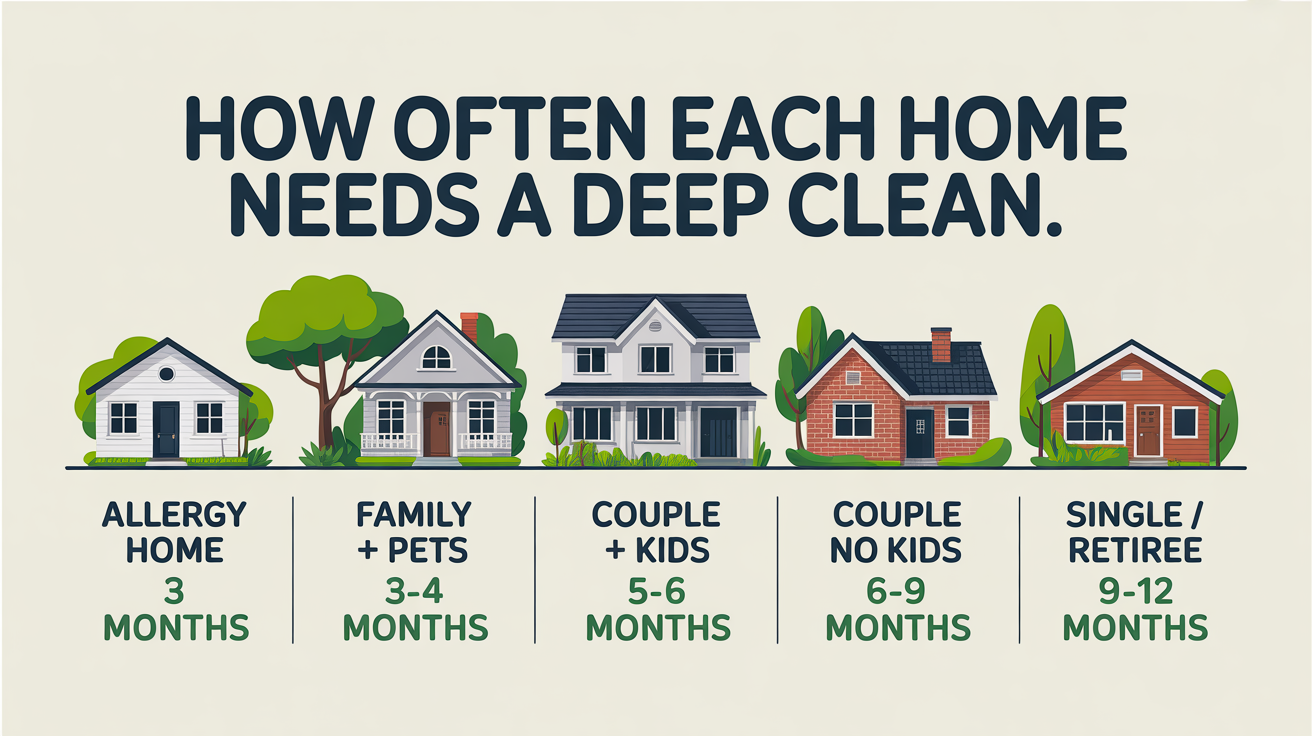
After 1,200+ deep cleans across Northeast Victoria, the pattern is consistent. Households fall into one of five buckets, and the right frequency tracks closely with which bucket you sit in.
- Family with kids and a pet (3+ occupants): Every 3–4 months. Sticky surfaces, fur in upholstery, more food traffic, more bathroom use. Skirting boards build up fast. If anyone has allergies, push closer to 3 months.
- Couple with one or two kids, no pets: Every 4–6 months. Manageable surface volume, but kitchen splatter and bathroom soap scum still climb quickly between visits.
- Couple, no kids, no pets: Every 6–9 months. The classic textbook answer fits here best. Watch for dust on top of joinery and behind appliances — that is your tell.
- Single occupant or retiree: Every 9–12 months works if regular cleaning is consistent. Push earlier if mobility makes reaching corners or behind furniture difficult.
- Allergy or asthma household (any size): Every 3 months minimum, ideally with focus on carpets, mattresses, and air vents. This is non-negotiable if symptoms are flaring.
Notice that the trigger is not just household size — it is what gets generated and what hangs around. A single person who cooks every night with a wok generates more kitchen grease in six months than a couple who eats out four nights a week.
Seven signs your home is overdue
The frequency rule is a forecast. The signs below are the actual signal.
- The bathroom does not smell fresh after a regular clean. Bleach-bright smell fades fast — what stays is hidden grime.
- Grout has shifted colour. White to grey, or beige to brown. That is biofilm and soap scum living in the porous surface.
- Window tracks have a visible film of grit. Run your finger along one. If anything comes up, it is overdue.
- Skirting boards have a chalky outline. A grey halo near the floor is a mix of dust, pet dander, and humidity.
- The top of the fridge or kitchen cabinets has a dust crust. Reach up. If your fingers come away gritty, it is months past due.
- Surfaces look fine but feel slightly tacky. Common on benches, range hoods, and door frames — cooking oil aerosol settles invisibly until you touch it.
- Allergy symptoms get worse at home, not better. If hayfever or asthma kicks in when you walk in the door, settled dust and dander are the most likely culprit.
If three or more of these are present, you are not on the early end of the cycle — you are past due. Booking sooner stops the next round of build-up from compounding on what is already there.
What changes after a proper deep clean
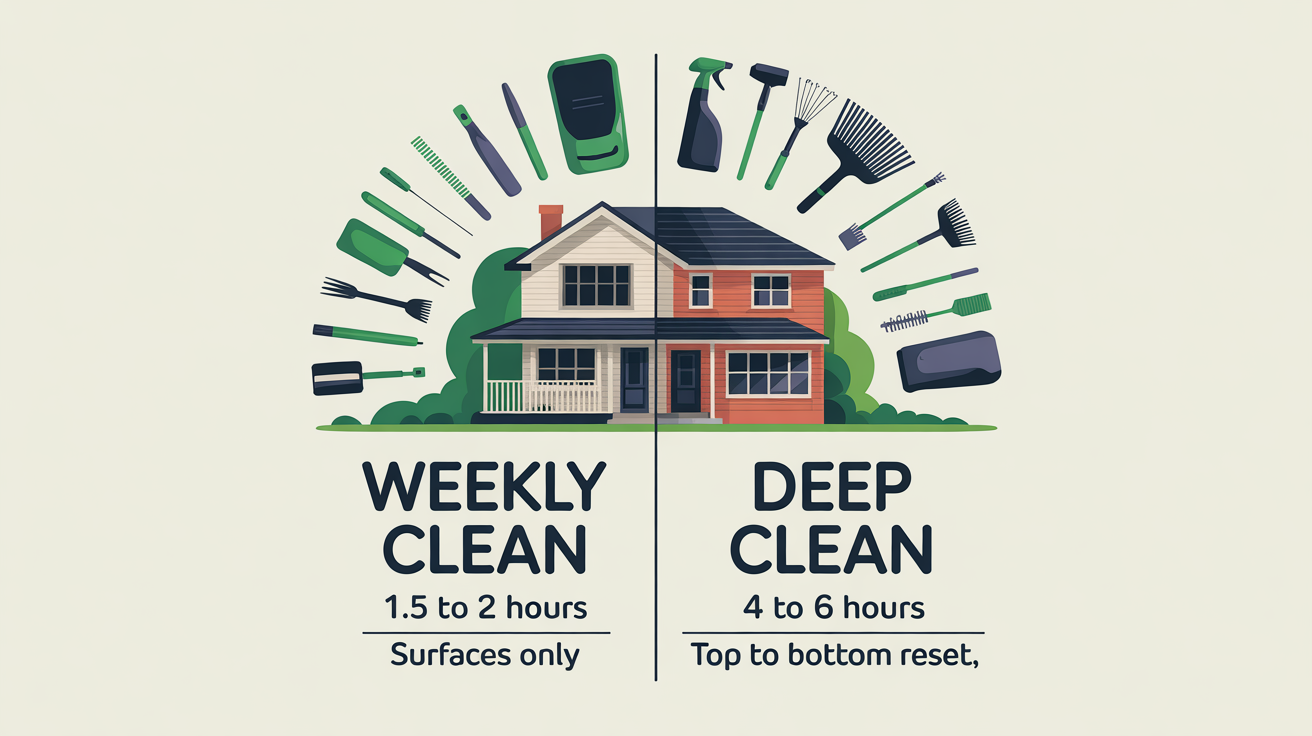
The visible difference is the surface — grout brightens, taps shine, range hood filters lose their amber tint. The bigger difference is what you stop having to do.
Regular cleans get easier when the base layer is clean. The cleaner is no longer fighting accumulated soap scum every Tuesday — they are maintaining a surface that is already at zero. That means a weekly clean takes 20–30 minutes less, costs less if you book by the hour, and the home looks reliably presentable instead of “tidy but not fresh.”
Air quality also shifts. Dust mites feed on skin flakes and pet dander accumulated in carpets, mattresses, and soft furnishings. Deep cleaning resets that population. Households with allergies often notice a clear 4–8 week window of easier breathing after a thorough deep clean — which is exactly why the 3-month frequency for allergy households is the most evidence-based number on this page.
Want a deep clean that actually lasts?
Free walkthrough. Fixed price. Same owner-operator every visit.
The maths — what frequency does to your annual cleaning bill
A deep clean is a bigger one-off cost than a regular visit, but spreading it across the year usually reduces total spend, not increases it. Here is how the maths shakes out for a typical 3–4 bedroom home in Wangaratta:
- No deep cleans, weekly regular clean only: Surfaces compound over 12 months. The regular clean takes longer each visit. By month 9 the weekly is taking 30% more time, costing 30% more.
- One deep clean per year + weekly regular: The regular visit resets after the deep clean, then drifts again. Annual total drops by ~15%.
- Two deep cleans per year + fortnightly regular: Maintenance-mode cleaning. Annual total often drops 20–25% vs the weekly-only plan, and the home looks consistently presentable.
Numbers vary by home, but the pattern is the same: a deep clean is rarely a luxury cost. It is the most expensive single visit and the cheapest annual decision.
Indicative annual totals for a 3-bedroom Wangaratta home. Actual numbers vary by home size and condition — we provide a fixed quote after a free walkthrough.
The four habits that make a deep clean last longer
The schedule above assumes a baseline of regular maintenance between deep cleans. If those four habits are in place, you can stretch the frequency by 2–3 months.
- Wipe the range hood every fortnight. Grease is the single fastest accumulator. Two minutes with a vinegar spray buys you months.
- Squeegee the shower after use. Stops soap scum and mineral spots forming. Five seconds a day.
- Vacuum upholstery and mattresses once a month. Bypassing this is why allergy households need higher frequency.
- Wipe window tracks once per season. A cotton bud and a damp cloth. Stops the grit-and-spider build-up that takes a deep clean to remove.
How Green Koala does deep cleans differently
Most cleaners deep-clean to a generic checklist. We deep-clean to the home. Before every deep clean, Hamish walks the property with you, notes the priority areas — usually a kitchen range hood, a problem bathroom, or a forgotten laundry — and adjusts the time allocation across rooms. You see the same owner-operator on the day, working off the priority list, not a clipboard checklist.
We photograph the before and after on every deep clean. That way you can see what changed, and we have a record of what was completed. For Airbnb hosts and NDIS participants, the photo log is also useful documentation.
To talk through what frequency makes sense for your home, request a free quote or call 0493 295 032. We service Wangaratta, Beechworth, Benalla, Bright, Myrtleford, Rutherglen, Chiltern, and 90+ towns across Northeast Victoria.
- ✓Three or more ‘signs your home is overdue’ apply
- ✓It has been 9+ months and you have kids or pets
- ✓Someone in the household has allergies or asthma flaring at home
- ✓Grout, tracks, or skirting boards look chalky or grey
- ✓You have just renovated, moved in, or hosted a big event
- ✓The home feels tidy but not fresh, even after a normal clean
Frequently Asked Questions
How often should I deep clean if I have pets?+
Is a deep clean really worth it twice a year?+
How long after a renovation should I deep clean?+
Will a deep clean help my allergies long-term?+
Can I just do a deep clean myself?+
How long does a deep clean take?+
What does a deep clean cost in Wangaratta?+
Can deep cleans be split across multiple visits?+
Sources & further reading
- Cleaning the home — Better Health Channel Victorian Department of Health
- Indoor allergens and asthma triggers Asthma Australia
- Dust mites — fact sheet Healthdirect Australia
- Indoor air quality at home — guidance Australian Government Department of Health
- Choosing a cleaner — Australian Consumer Law guidance Australian Competition and Consumer Commission
- Pet dander and allergies in the home Australasian Society of Clinical Immunology and Allergy
Ready for a Deep Clean That Actually Lasts?
Free walkthrough. Fixed price. Same owner-operator every visit. Wangaratta + 90 towns across Northeast Victoria.