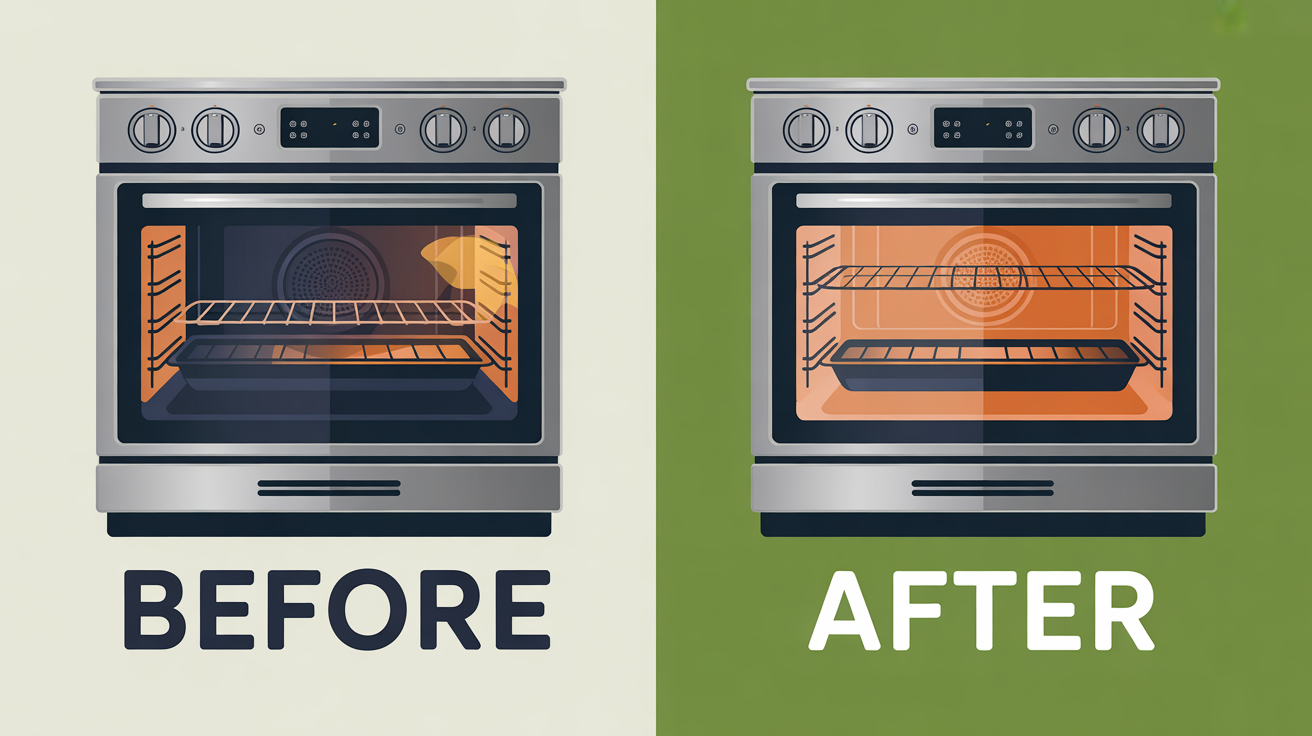
An oven deep clean is the slowest part of any kitchen reset — 30 to 45 minutes if it has not been done in a year. Here is the proper process: what cleaner to use on what surface, how long to wait, why abrasive pads ruin enamel, and the safety steps that protect your oven and your food.
Why ovens need their own protocol
Every other cleaning job in a kitchen is a wipe-and-rinse. An oven is different — it has baked-on carbon deposits that need chemical breakdown, glass that needs special care, enamel that abrasive pads scratch, and a self-cleaning function (on some models) that responds badly to commercial cleaners. Get the protocol right and the oven looks new. Get it wrong and you damage the unit.
Check first — is your oven self-cleaning?
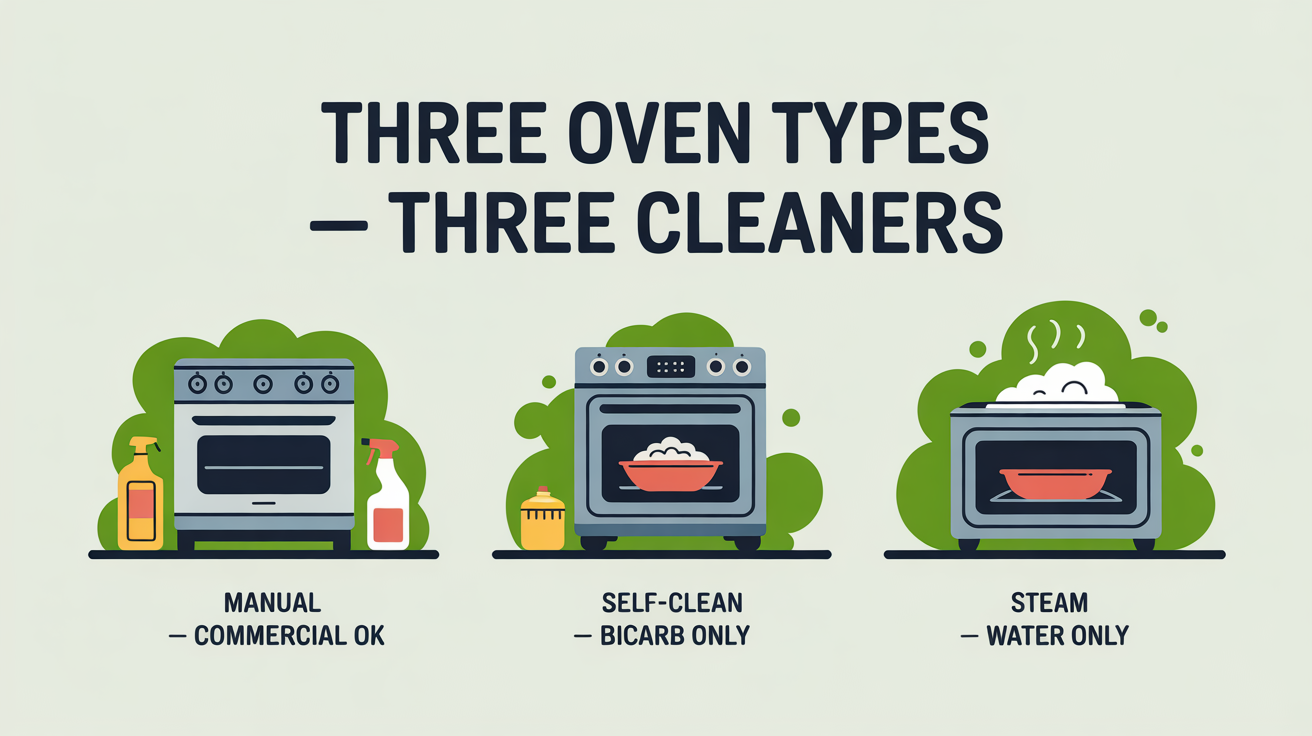
Self-cleaning ovens have a special enamel coating that commercial oven cleaners (e.g. Easy-Off) damage. The high pH chemistry strips the catalyst layer. If your oven has a self-clean cycle, NEVER use commercial cleaner — use a bicarbonate-of-soda + water paste instead. Check the manual if unsure.
- Manual cleaning models (most domestic): commercial oven cleaner is fine
- Self-cleaning models (pyrolytic, catalytic): bicarbonate paste ONLY
- Steam-cleaning models: water bowl method, no chemicals
Step 1 — Remove racks and runners
The racks need to come out first and soak. They have their own cleaning protocol.
- Pull out wire racks, side runners, pizza stones, baking trays
- Fill a sink (or bath) with hot water + dishwashing liquid + 1 tsp washing soda
- Soak for 20-30 min while you work on the oven interior
- Scrub with a non-abrasive pad after the soak
- Rinse and dry thoroughly before reinstalling
Step 2 — Apply cleaner to walls and let it dwell
The single biggest mistake in oven cleaning is not letting the cleaner sit long enough. Twenty minutes minimum.
- Spray or brush cleaner onto all interior surfaces (walls, floor, ceiling, door interior)
- Bicarbonate paste: smear thick layer with hands, let dwell overnight if possible
- Commercial: dwell 20-30 minutes, more if baked-on residue is heavy
- Avoid heating elements directly (top/bottom of oven cavity)
- Open window or use exhaust fan during commercial cleaner use
Want an oven that bakes evenly again?
Free walkthrough. We bring all chemicals and use the right one for your oven type.
Step 3 — Scrub gently, never abrasive
The enamel inside an oven is delicate. Abrasive pads (like steel wool) leave scratches that show forever and trap future grime. Only use:
- Non-abrasive scrub pad (e.g. Scotch-Brite non-scratch)
- Old toothbrush for corners and seal areas
- Plastic scraper for stubborn carbon (held at 45° angle)
- Microfibre cloth for final wipe-down
Step 4 — Glass door treatment
Oven door glass has its own challenge — the cleaner needs time to break down browned-on residue between the two glass panes.
- Make a paste of bicarbonate + water
- Apply generously to door interior
- Wait 20-30 min
- Scrub with non-abrasive pad
- Wipe with damp microfibre, then dry
- If there is residue between glass panes — most modern doors come apart for cleaning (check the manual). If not, a professional service can split them.
Step 5 — Rinse, rinse again, dry, reset
Cleaner residue is the worst thing to leave in an oven — it carbonises on the next bake and creates smoke and odd flavours in food.
- Wipe interior twice with damp microfibre + clean water
- Wipe a third time if commercial cleaner was used
- Dry thoroughly before reinstalling racks
- Check seal (the rubber gasket around the door) — if cracked, replace
- Run the oven at 180°C for 15 minutes empty to confirm no chemical smell
How often to deep clean your oven
If you cook 4+ nights a week, every 3-4 months. If 2-3 nights, every 6 months. If less, annually is fine.
A clean oven heats more evenly, uses less power, and produces better-tasting food. Carbon deposits absorb heat and create hot/cold zones in the cavity — that is why old ovens bake unevenly.
Request a free quote or call 0493 295 032. Wangaratta + 90 towns across Northeast Victoria.
- ✓Oven door glass has a brown haze you cannot wipe off
- ✓Food smells slightly burnt even when not overcooked
- ✓Baking is uneven (hot/cold zones)
- ✓There’s smoke during baking that wasn’t there before
- ✓Element area has visible carbon build-up
- ✓You can no longer read the oven model number on the inside
- ✓Last clean was more than 6 months ago
Frequently Asked Questions
Can you clean a self-cleaning oven?+
How long should I leave oven cleaner on?+
Will steel wool damage my oven?+
How do I clean between the glass panes in the door?+
Why does my oven smell of chemicals after cleaning?+
Will the deep clean make my oven bake better?+
Should I clean the heating elements?+
What if the door seal is damaged?+
Sources & further reading
- Consumer guarantees on services Australian Competition and Consumer Commission
- Reducing your home energy bills Australian Government — Department of Climate Change, Energy
- Cleaning the home — Better Health Channel Victorian Department of Health
- Indoor air quality at home — guidance Australian Government Department of Health
- Construction dust — workplace guidance WorkSafe Victoria
Ready for a Real Oven Reset?
Free quote. Fixed price. Right chemistry for your oven type. Wangaratta + 90 towns across Northeast Victoria.